


FREE AND CONFIDENTIAL SERVICES img Make an Appointment img (970) 239-2272
Menstrual Cycle Blog header

The Menstrual Cycle 101: What’s Actually Happening in Your Body Every Month?

When you think of “menstruation” or “the female menstrual cycle”, many only think of the week of the month where they’re actively bleeding or on their period. In reality? The menstrual cycle lasts all month long (between 28-34 days), and is made up of four distinct phases designed to support your body’s fertility. 
The menstrual cycle is one of the most intricate and constantly changing systems in the body, yet it remains one of the least understood by the very women who experience it.  Studies have shown that many women (33% under 25 years old) don’t know how long their cycle is, and nearly 10% don’t know how long their periods last.

Whether you’re trying to avoid pregnancy, get pregnant, or just learn more about your body, you’re in the right place.

A note on inclusivity: regardless of a person’s gender identity, those who were assigned female at birth (AFAB) will experience the menstrual cycle, except in outlying cases. In this article, “women” and “females” will be used to describe any person who is AFAB. When all of our patients come into the clinic, our nurses ask about their biological sex because it determines the type of testing needed to best protect their health

From KindBody

The Distinct Phases of the Female Menstrual Cycle

Between every 28-34 days, a woman’s body goes through four phases of the menstrual cycle to prepare their bodies for a possible pregnancy by preparing and releasing an egg (called an ovum) in the ovaries. It is measured from the first day of your last menstrual cycle, also known as LMP and lasts until the first day of the next menstrual cycle. 

During each of these phases, your hormone levels change to support the possible pregnancy by preparing the egg and the uterine lining, releasing the egg, and either supporting implantation or breaking down the lining to create a fresh one for the next cycle

How long is a normal menstrual cycle?

The average number of days between your menstrual periods is 28 days, although lengths between 21 and 35 days are considered normal, and bleeding lasts between 3-7 days. Only 15% of women have a 28 day cycle exactly, so while 28 days is average, it’s completely normal for it to be slightly shorter or longer than this.

Menstruation

The follicular phase begins with menstruation and continues into preparing another egg for fertilization. When conception does not occur, your hormones drop to their lowest levels, signaling the unfertilized egg to dissolve in the uterus and the blood and tissue that was built up in your uterus in preparation for implantation flows out from your uterus through your cervix and out of your body through the vagina. The period of bleeding is called your period. 

After the onset of your period as a teen (menarche), it can take up to three years for your cycle to regulate as your body gets used to the hormone changes that happen each month. Your period may change again after pregnancy, during breastfeeding, or because of other health problems. Tracking your period helps you to know what’s normal for your body.

During your period, you can expect to lose between two and three tablespoons of blood.

Period or pms symptoms

Symptoms of your period vary from woman to woman, and sometimes from cycle to cycle. While the cause of symptoms is unclear, it seems to be related to the hormone fluctuations happening in your body and/or changes in brain chemicals during your period. These may include:

  • Mood changes or swings
  • Sleep changes
  • Headache
  • Bloating
  • Breast tenderness
  • Acne
  • Cramping
  • Nausea
  • Constipation or diarrhea

Can I get pregnant while on my period?

The possibility of getting pregnant while on your period is low because ovulation (in most cases) is still a few weeks away. However, if you have a shorter cycle and have unprotected sex near the end of your period, it is possible for sperm to stick around long enough to fertilize the next egg that is ovulated. The best rule of thumb is to always use protection or birth control if you are not wanting to become pregnant.

If I get my period, is it possible that I'm still pregnant?

Your period arriving means that implantation has not occurred, so the uterine lining is being shed and you are not pregnant. 

If your period is abnormally light (you don’t need a pad or tampon) and only lasts a few days following unprotected sex since your last cycle, it’s possible that it could be implantation bleeding. If your regular period doesn’t arrive within the following week or two, it may be wise to take a pregnancy test.

What’s important to remember is that your ability to become pregnant resets every cycle. Within 6 months, 70-75% of couples not using protection will get pregnant.  If you don’t want to be pregnant, be sure to use some form of birth control and/or barrier methods

The Follicular phase

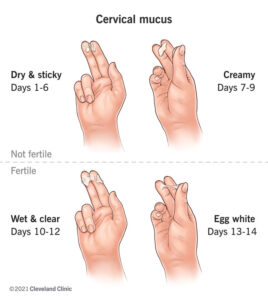
cervical mucus changes during the menstrual cycle

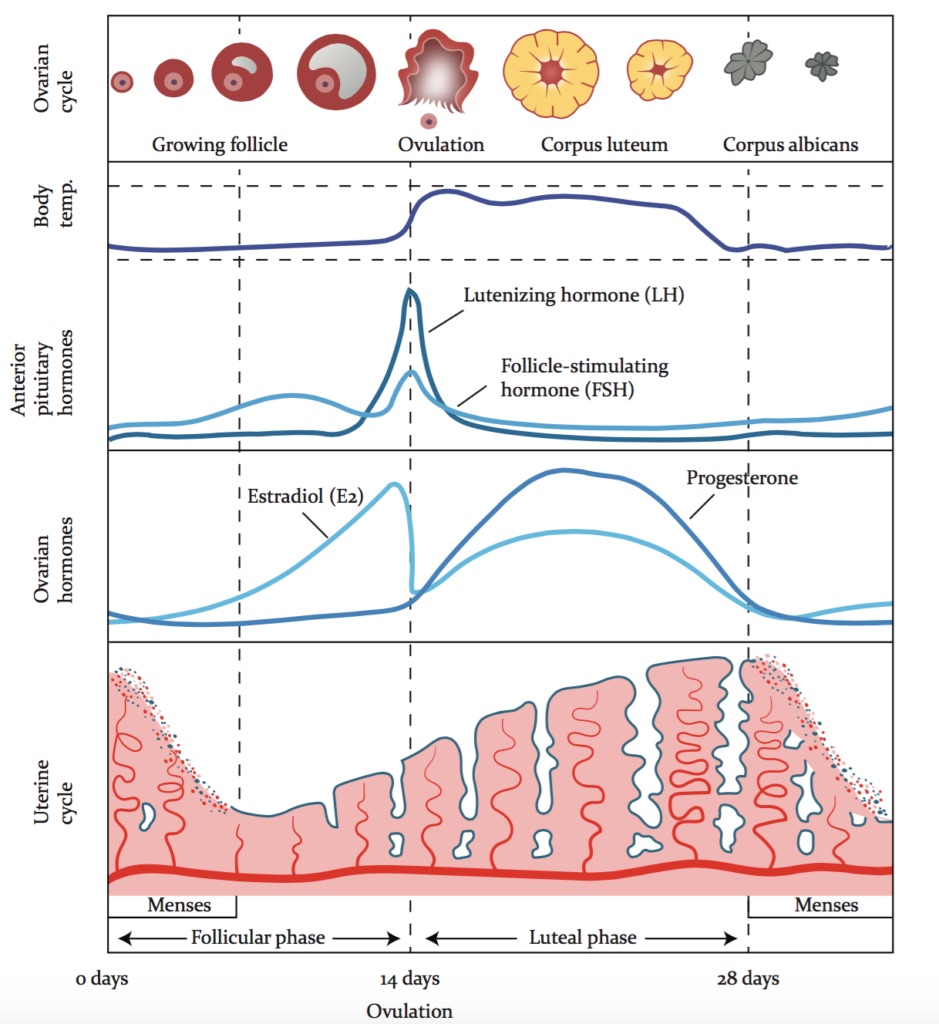
The follicular phase is the first half and longest phase of your menstrual cycle, beginning on the first day of menstruation and lasting until ovulation. It is also called the pre-ovulatory or proliferative phase. It begins with the pituitary gland in your brain, which produces follicle-stimulating hormone (FSH). FSH activates your ovaries to start producing follicles, fluid-filled sacs that contain between 11-20 developing eggs. One will begin to develop more quickly than the others, and become the dominant follicle. This follicle releases estrogen to begin to thicken your uterine lining, so that if the egg becomes fertilized, the embryo is able to implant. It also triggers a decrease in FSH so that your body stops producing follicles and the unused ones reabsorb into your body. The dominant follicle continues to mature. Towards the end of the follicular phase, the higher estrogen levels trigger the production of luteinizing hormone (LH) and activates ovulation and the beginning of the luteal phase.

How do you feel during the follicular phase?

You may feel a variety of ways during the follicular phase of your menstrual cycle. Following your period, you may feel more confident, more energized and have a higher libido.

Can you get pregnant during the follicular phase?

You can’t get pregnant before an egg has been released. However, the five days leading up to ovulation occur during the follicular phase and that is the time you are most likely to become pregnant. Sperm can live for up to five days, so even if you have sex four days before ovulation, you can still become pregnant. If you are not wanting to become pregnant, utilize the barrier method, abstinence, or another form of birth control during this time.

Ovulation

Ovulation signals the beginning of the luteal phase of the menstrual cycle. Around day 14, a surge in LH causes the dominant follicle to release the ovum into your fallopian tube, and voila, you’ve ovulated! The ovum is then moved along into the fallopian tube and waits for fertilization to occur. See video explanation here.

Symptoms

From one to five days before you ovulate, many women notice discharge from the vagina that looks like egg white. This discharge helps move sperm from the vagina and cervix up to the fallopian tube. Women may also experience light spotting, an increase in libido, bloating, a brief twinge of pain on one side of the abdomen, or breast tenderness. If you’re tracking your basal body temperature, a slight increase in temperature, less than half a degree, is common, and women are most fertile (or likely to become pregnant) in the two to three days before your body temperature rises. 

Can I ovulate more than once during my menstrual cycle?

Generally, no. Your body’s cycle is a balance of hormones that allow your ovaries to ovulate just once per cycle. However, it is possible to mature and release more than one egg. This is the cause of fraternal twins, and occurs between 5-10% of all menstrual cycles.

Can you get pregnant during ovulation?

YES. While the egg can only be fertilized for 12-24 hours after ovulation, sperm can live for approximately 5 days in the female reproductive tract, meaning that your most fertile window is between 5-7 days surrounding ovulation. This is the time that pregnancy is most likely to occur, and if you are not wanting to be pregnant, a barrier such as a condom or abstaining from intercourse is recommended.

The Luteal Phase

The luteal phase starts after ovulation and lasts into either pregnancy or the start of another menstrual cycle, and commonly occurs between days 15-28 of your cycle. Following ovulation, the now- empty follicle develops into a temporary gland called a corpus luteum. The corpus luteum produces estrogen and progesterone. Progesterone builds the uterine lining and prepares it to receive the fertilized egg (embryo) for implantation. 

If the egg was not fertilized, it dissolves and the endometrial lining begins to break down and shed, which starts the beginning of your next menstrual cycle. Your progesterone and estrogen levels then drop, which can bring on symptoms of pre-menstrual syndrome (PMS).

If you conceive, the fertilized egg (also called a blastocyst) travels through your fallopian tubes and implants in the lining of the uterus, and you may start to feel the symptoms of early pregnancy.


Physical Symptoms

During the luteal phase of your cycle, progesterone levels rise in the body as your body prepares for the possibility of fertilization and pregnancy. If pregnancy doesn’t happen, then the hormone levels come back down and cause symptoms of PMS. 

Common symptoms during the luteal phase of your menstrual cycle may include:
  • Mood swings caused by dropping estrogen and progesterone levels near the end
  • Bloating and water retention can occur as progesterone may slow down digestion and affect the balance of fluid in your body
  • Fatigue
  • Breast tenderness
  • Skin changes and acne may occur along the jawline as sebum production increases
  • If you’re tracking BBT, your temperature typically increases between .5-1 degree F (.3-.6 degrees celsius) and stays elevated until your period starts. 
  • Cravings and increased appetite

If your PMS symptoms feel particularly intense or cause a number of disruptions in your daily life, you may be experiencing PMDD, premenstrual dysphoric disorder. If you think that your symptoms are abnormal, be sure to talk to your primary care physician or gynecologist.

final thoughts on the menstrual cycle

While length, symptoms, and experiences will differ from person to person, your body is doing what it was meant to do and finding your normal can help you to notice when something is off. The menstrual cycle is often called the “fifth vital sign” and tracking your cycle, whether you do that digitally or manually, can help you gain important insight into your body.

frequently asked questions

  • Can I track fertility and my menstrual cycle by tracking my cervical mucus changes?

    Yes, cervical mucus changes can tell you when you’re fertile or most likely to get pregnant. Tracking discharge can also clue you in to cycle irregularities. 

    • Dry and Sticky: Days 1-6
    • Creamy: Days 7-9
    • Wet and Clear: Days 10-12
    • Egg White: Days 13-14
    • After ovulation: Returns back to thick and dry

    Learn more about fertility awareness based methods of birth control.

  • What is Basal Body Temperature?

    Basal Body Temperature (BBT) is your body temperature when you are most at rest (when you first wake up).

    Following ovulation, a rise in BBT that lasts for 18 or more days can be an indicator of early pregnancy.  If you are tracking BBT to prevent pregnancy, unprotected sex is a no-go from the beginning of your period until 3-4 days after your BBT rises every month.

  • Can I get pregnant during the luteal phase?

    Post-ovulation, the egg is only able to be fertilized for approximately 12-24 hours. After this point, the egg is no longer able to be fertilized, and the days leading up to your period are the ones that you are least likely to become pregnant.

  • When does the follicular phase start and end?

    The follicular phase begins on the first day of your period and lasts until ovulation.

  • How long does the follicular phase last?

    While it typically lasts about 14 days in a 28-day cycle, it is the most variable part of the menstrual cycle and can range from 10 to 20 days.

  • What is the difference between the follicular and luteal phases?

    The follicular phase is about egg maturation and the proliferative growth of the uterine lining, whereas the luteal phase follows ovulation and is dominated by progesterone.

  • How does the follicular phase affect basal body temperature?

    In this phase, temperature is usually lower (between 97°F and 97.6°F) compared to the luteal phase.

  • What are the signs of a problem with my menstrual problem?

    Every menstrual cycle is different, which is why tracking your cycle and symptoms can help you to determine a baseline for what is normal and what’s not for your body. You may want to consider talking to your doctor if you’re skipping periods, your periods are irregular, you bleed for longer than 7 days, you have bleeding that’s heavier than spotting in between your periods, or you consistently have periods less than 21 days apart.

Sources:

Authored by Kristen Long, Alpha Center. Last Updated June 4, 2026. Reviewed by Meghan Downing, RN, Nurse Manager
understanding chlamydia
Abortion

Chlamydia: Symptoms, Treatment, and Resources in Fort Collins, Colorado

April is Sexually Transmitted Infections Awareness Month, making it the perfect time to learn about Chlamydia, the most commonly reported STI in Colorado. This bacterial infection, caused by Chlamydia trachomatis, often goes unnoticed, with up to 75% of individuals showing no symptoms. Understanding how Chlamydia spreads, its symptoms, and the importance of regular testing can help protect your health and that of your partners. At Alpha Center, we offer no-cost testing and treatment if you test positive for Chlamydia. Discover how to stay informed and safe—read on to learn more about Chlamydia and its impact on your sexual health!

Read More »